

How can a business improve cash flow without paying suppliers late?

In short
Pay approved supplier invoices with your commercial card through ipaymy, and use the card’s credit line to decide when cash leaves your business.
Your supplier gets a bank transfer on the date you choose, and you settle the card balance later, on your normal billing cycle. Depending on when the charge lands and your issuer’s terms, that can be up to 55 days after the card is charged, interest-free as long as you pay the balance in full by the due date.
Your bank provides the card and its credit limit. ipaymy simply makes the payment to your supplier.
Why payment timing matters
Most finance teams know the trade-off. The usual way to hold on to cash longer is to pay suppliers later, and suppliers notice. It tends to come back to you in pricing, in how your orders are prioritised, or in the terms you’re offered next time.
It helps to see that every approved invoice involves two separate decisions:
- When should the supplier be paid?
- When should cash leave the business?
When you pay by bank transfer, those two decisions become one: the supplier is paid and your cash balance drops on the same day.
Paying by commercial card pulls them apart. Your supplier is still paid on the agreed date, but your cash only leaves when the card balance falls due.
Your supplier’s date doesn’t move. What changes is how much say you have over your own cash.
How it works
Approve the invoice as usual.
Pay by commercial card through ipaymy.
The supplier receives a bank transfer.
You settle the card balance on your billing cycle.
A worked timeline
Here’s how that plays out on a card whose statement closes on the 1st of each month, with payment due 25 days later.
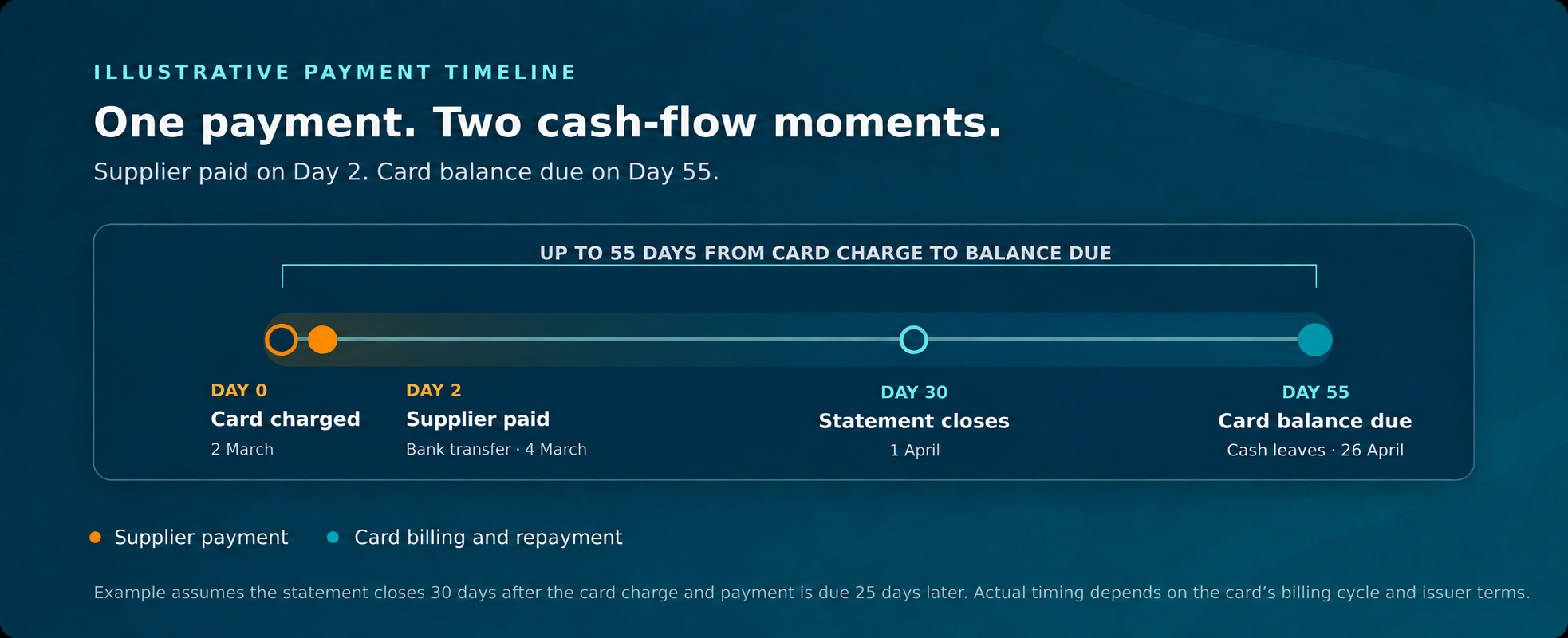
- Day 0: Card charged just after the statement closes.
- Day 2: Supplier paid on the date selected.
- Day 30: Next statement closes.
- Day 55: Card balance due.
So your supplier has had their money since Day 2, and your cash doesn’t leave until Day 55.
Timing matters here. You get the longest window when the charge lands just after your statement closes, so check your own statement and due dates before you plan around the full 55 days.
Does it extend DPO?
It’s a fair question, and the answer is that it depends. Your cash goes out later and your supplier’s terms stay the same. Whether that shows up in reported DPO comes down to how the card balance is classified, so agree the treatment with your auditors before you report on it.
A few things to be clear about
- This isn’t a loan from ipaymy. We don’t lend or issue cards. Your bank approves and provides the card and its credit limit.
- Your suppliers aren’t asked to do anything. Where your business pays the service fee, suppliers receive the full invoice amount and don’t need to accept cards, join a programme or discount their invoices.
- Your supplier terms stay as they are. Suppliers are paid on the date you agreed with them.
- It won’t suit every invoice. Use it where the extra days are worth more than the fee, and pay directly where they aren’t.
The questions each team will ask
What this means in practice
The simplest way to decide is to put a number on the extra days:
Timing value = payment amount × annual cost of funds × additional days ÷ 365
Take a S$100,000 invoice. Your supplier receives the full S$100,000 on Day 2, and your business keeps that cash until Day 55, which is 53 extra days.
Over those 53 days, every percentage point of annual cost of funds is worth about S$145. If your cost of funds is 5%, that’s roughly S$726 on one invoice. Use your own cost of funds rather than a market benchmark, since that’s the number your CFO will test it against.
Then set that against the service fee. Card rebates, the bank-facility headroom you keep and any operational benefits are worth weighing too, but keep them separate from the core calculation.
When it makes sense
Strong candidates:
- Large or recurring invoices where the supplier requires bank transfer
- Payments where the days of cash retained are worth more than the service fee
- Card limits with enough headroom, and a balance the business can pay in full when due
Less suitable:
- The service fee, after any rebate, is more than the value of the days
- The business may not pay the card balance in full by the due date
- The payment or recipient isn't eligible
- Paying direct earns better commercial terms, such as an early-payment discount
How ipaymy helps
ipaymy lets businesses pay approved supplier invoices by commercial card, with suppliers paid by bank transfer even when they do not accept cards. You choose the supplier's payment date, and ipaymy sets the charge date for that market.
In a supplier-funded programme, one communications technology company used this approach to pay 120+ suppliers by card and extend its reported DPO from 30 to 69 days. Read the customer story.
Payment history can be exported for reconciliation, including recipient, payout date, amount and service fee. Eligibility, processing times, service fees and rewards vary by market, card and payment type.
The bottom line
Your suppliers have kept their side of the deal, and they should be paid on time. Paying by commercial card lets you do that while deciding when the cash actually leaves your account, up to 55 days from the card charge. Start with the invoices where those days are worth more than the fee.
Speak with our enterprise team.
Common questions
Is this the same as extending supplier payment terms?+
Does the supplier need to accept cards?+
How many extra days can a business get?+
Is it interest-free?+
Does it increase reported DPO?+
Is ipaymy lending to my business?+
Can every supplier invoice be paid this way?+

Make every payment work harder

Follow us


